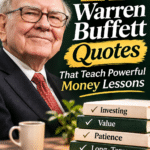
Warren Buffett quotes reveal timeless lessons about money, investing, patience, and building wealth. Explore 21 principles inspired by his shareholder letters, with practical tips for beginners who want to make smarter financial decisions.
Explore the Compound Interest Calculator
Read Berkshire Hathaway Shareholder Letters
21 Warren Buffett Quotes That Teach Powerful Money Lessons
Are you tired of conflicting investment advice, market predictions, and promises of getting rich quickly?
Warren Buffett’s investing philosophy offers a different perspective. Rather than chasing every new opportunity, he has emphasized understanding businesses, paying sensible prices, managing risk, and thinking long term.
These 21 Warren Buffett quotes and investing lessons explore the principles behind his approach to money and wealth building.
Each lesson includes a practical takeaway to help beginners develop better financial habits.
Editorial note: The numbered lessons below are original summaries of Buffett’s investing principles, not verbatim quotations. They draw primarily from Berkshire Hathaway’s published shareholder letters.
Who Is Warren Buffett and Why Do His Money Lessons Matter?
Warren Buffett is an American investor and longtime leader of Berkshire Hathaway, a company known for its investments and ownership of businesses across different industries.
His approach to investing emphasizes business fundamentals, long-term ownership, financial discipline, and the difference between a company’s market price and its underlying value.
For individual investors, the most useful lesson may be that successful investing does not require predicting every market movement.
It requires understanding what you own, recognizing uncertainty, and following a plan suited to your circumstances.
21 Warren Buffett Investing Lessons That Can Change How You Think About Money
1. Understand What You Are Buying
Money Lesson #1: Never confuse a popular investment with an investment you understand.
Buffett has emphasized staying within your circle of competence. Investors should understand how a business earns money, what drives its profits, and what could threaten its future.
Buying a stock because it is trending on social media is not the same as understanding the company behind it.
Practical action: Before investing, explain the business model in three simple sentences. If you cannot, research further.
2. Think Like a Business Owner
Money Lesson #2: A stock represents ownership in a business, not merely a moving price on a screen.
Buffett’s investing philosophy treats shares as partial ownership of real businesses.
Instead of focusing only on daily price changes, consider earnings, competitive advantages, management, and long-term business prospects.
Practical action: Review a company’s annual report before making a significant investment.
3. Price and Value Are Different
Money Lesson #3: A low price does not automatically mean a good investment.
One of Buffett’s central principles is the distinction between what an asset costs and what it is worth.
A company with a low share price can still be expensive relative to its earnings and prospects. A higher-priced company may offer better value if its fundamentals justify the price.
Practical action: Learn basic valuation concepts before assuming that a stock is cheap.
4. Patience Is an Investing Advantage
Money Lesson #4: Give a sound long-term investment strategy enough time to work.
Short-term market fluctuations can distract investors from their original goals.
Buffett has consistently emphasized long investment horizons, although holding an investment for many years does not guarantee success.
Practical action: Match your investments to your financial goals and time horizon.
5. Avoid Following the Crowd Blindly
Money Lesson #5: Popular opinion should never replace independent thinking.
Markets can become emotional during periods of excitement or fear.
Buffett’s philosophy encourages investors to evaluate opportunities based on evidence rather than automatically following market sentiment.
Practical action: Write down your reasons for buying an investment before committing money.
6. Protect Your Financial Foundation
Money Lesson #6: Financial resilience matters before investment returns.
Investing is easier to approach thoughtfully when unexpected expenses are less likely to force you to sell assets at an unfavorable time.
Emergency savings, appropriate insurance, and manageable debt can support long-term financial planning.
Practical action: Review your emergency fund before increasing investment risk.
7. Understand the Risks You Take
Money Lesson #7: The possibility of earning more should never distract you from the possibility of losing money.
Buffett’s approach considers business risk, financial strength, and the price paid for an investment.
Even a strong company can become a poor investment when purchased at an excessive valuation.
Practical action: Consider what could go wrong and how much loss you could tolerate.
8. Invest Within Your Circle of Competence
Money Lesson #8: You do not need to understand every opportunity to become a more informed investor.
There are thousands of companies and financial products available.
Buffett’s approach does not require expertise in every industry. It emphasizes knowing the boundaries of your understanding.
Practical action: Avoid making concentrated investments in businesses you cannot evaluate.
9. Business Quality Matters
Money Lesson #9: Look beyond the purchase price and examine the quality of the underlying business.
Strong businesses may possess competitive advantages, reliable customer demand, sound management, and sustainable economics.
However, even excellent companies can experience disappointing results.
Practical action: Research profitability, debt, competition, and long-term demand.
10. Keep Investment Costs Under Control
Money Lesson #10: Money lost to unnecessary fees is money that cannot compound for your future.
Buffett has repeatedly discussed the impact of investment costs and has expressed support for low-cost index funds for many ordinary investors.
Fees may appear small, but recurring costs can meaningfully reduce long-term returns.
Practical action: Compare expense ratios, account fees, and transaction costs.
11. Avoid Unnecessary Trading
Money Lesson #11: More activity does not necessarily produce better investment results.
Frequent trading can increase costs, create tax consequences, and encourage emotionally driven decisions.
A disciplined investment plan may be more useful than reacting to every headline.
Practical action: Establish clear rules for reviewing and adjusting your portfolio.
12. Learn From Financial Mistakes
Money Lesson #12: An investment mistake becomes valuable when it improves your future decisions.
Buffett has openly discussed unsuccessful investments in Berkshire Hathaway’s shareholder letters.
Reviewing mistakes helps investors recognize weaknesses in their assumptions and decision-making processes.
Practical action: Keep a short investment journal documenting your reasoning and outcomes.
13. Avoid Excessive Borrowing
Money Lesson #13: Borrowed money can magnify losses as well as gains.
Leverage can increase financial pressure when markets decline or borrowing costs rise.
Investors should understand margin requirements, interest expenses, and the possibility of forced liquidation.
Practical action: Do not use investment leverage without fully understanding the consequences.
14. Build Wealth With a Long-Term Perspective
Money Lesson #14: Financial decisions should support your future, not just today’s excitement.
Long-term investing allows investors to focus on sustainable business performance instead of daily market movements.
However, a long holding period does not eliminate risk or guarantee positive returns.
Practical action: Define whether each investment supports a short-, medium-, or long-term goal.
15. Appreciate the Power of Compounding
Money Lesson #15: Time can be a powerful financial resource when combined with consistent saving and growth.
Compounding occurs when returns begin generating additional returns.
Its effects depend on the rate of return, time period, fees, taxes, and whether returns are positive or negative.
Practical action: Explore how different contribution amounts and hypothetical growth rates affect long-term savings.
16. Know When an Opportunity Is Outside Your Expertise
Money Lesson #16: Passing on an investment you do not understand can be a reasonable decision.
Investors often feel pressure to participate in rapidly growing industries or popular market trends.
Buffett’s philosophy emphasizes selectivity rather than participation in every opportunity.
Practical action: Create a checklist of questions that must be answered before you invest.
17. Separate Market Volatility From Business Performance
Money Lesson #17: A changing stock price does not always mean the underlying business has changed.
Stock prices move because of expectations, economic developments, investor sentiment, and company-specific news.
Long-term investors should distinguish temporary price movements from changes in business fundamentals.
Practical action: Review earnings and financial reports rather than relying exclusively on price charts.
18. Be Realistic About Future Returns
Money Lesson #18: An investment plan should not depend on extraordinary returns every year.
Past performance is not a reliable guarantee of future results.
Buffett has acknowledged that Berkshire Hathaway’s historical growth rates cannot be assumed to continue indefinitely.
Practical action: Test your financial plan using more than one possible return scenario.
19. Focus on Sustainable Competitive Advantages
Money Lesson #19: A business needs more than temporary popularity to remain successful.
Companies with durable competitive advantages may be better positioned to withstand competition.
Buffett has discussed the importance of businesses whose strengths may remain relevant for many years.
Practical action: Consider customer loyalty, switching costs, brand strength, and industry competition.
20. Keep Your Financial Strategy Understandable
Money Lesson #20: Complexity is not a requirement for intelligent investing.
Financial products can become difficult to evaluate when they contain multiple layers of fees, leverage, or complicated structures.
Buffett’s philosophy places significant importance on understanding what you own.
Practical action: Ask yourself whether you can explain an investment’s costs, risks, and potential returns in plain language.
21. Make Decisions Based on Principles, Not Predictions
Money Lesson #21: A repeatable financial process can be more useful than trying to predict every market movement.
Economic forecasts and market predictions are inherently uncertain.
A long-term plan built around financial goals, risk tolerance, diversification, and reasonable expectations can help investors navigate that uncertainty.
Practical action: Write a personal investment policy explaining your goals, acceptable risks, and review schedule.
Warren Buffett Money Lessons: Quick Summary
| Principle | Practical Application |
|---|---|
| Understand investments | Research before buying |
| Think long term | Match investments to goals |
| Control costs | Compare fees and expenses |
| Manage risk | Avoid excessive leverage |
| Understand value | Compare price with fundamentals |
| Stay disciplined | Follow a realistic plan |
How to Apply Warren Buffett’s Money Lessons as a Beginner
You do not need to copy Berkshire Hathaway’s investment portfolio to learn from Buffett’s philosophy.
Instead, start with a financial foundation appropriate for your own circumstances.
- Review your finances: Understand your income, expenses, savings, and debt.
- Build emergency savings: Prepare for unexpected costs before taking unnecessary investment risks.
- Learn the fundamentals: Understand diversification, fees, inflation, and compound growth.
- Choose suitable investments: Consider your goals, time horizon, and risk tolerance.
- Avoid emotional decisions: Do not automatically follow social media investment trends.
- Review periodically: Reassess your plan when your circumstances change.
How Compounding Can Affect Long-Term Wealth
Consider an investor who contributes $200 per month for 20 years.
The table below compares hypothetical outcomes using monthly contributions at the end of each month and monthly compounding.
| Assumed Annual Return | Approximate Value After 20 Years |
|---|---|
| 0% | $48,000 |
| 4% | $73,355 |
| 6% | $92,408 |
| 8% | $117,804 |
These figures are illustrative, not forecasts. They assume constant hypothetical returns and exclude taxes, fees, and inflation. Actual investments may lose value.
Use the official Investor.gov calculator to explore different savings scenarios.
Explore the Compound Interest Calculator
Common Mistakes to Avoid When Following Warren Buffett’s Advice
Buffett’s investing philosophy is influential, but applying it without considering your own financial situation can create problems.
- Copying individual stock purchases: Berkshire Hathaway has different resources, information, and financial objectives from most retail investors.
- Ignoring diversification: A concentrated portfolio may create risks that an individual investor cannot comfortably absorb.
- Assuming every decline is a buying opportunity: Some businesses decline because their fundamentals deteriorate.
- Investing emergency savings: Money needed soon may not be suitable for volatile assets.
- Confusing patience with refusing to reassess: Long-term investing still requires monitoring investment fundamentals.
Frequently Asked Questions About Warren Buffett Quotes
1. What is Warren Buffett’s most important investing lesson?
One of his most enduring principles is to understand the business behind an investment and consider its value relative to the price paid.
2. Does Warren Buffett recommend index funds?
Buffett has expressed support for low-cost index funds as a practical approach for many investors who do not want to select individual stocks.
3. Can beginners follow Warren Buffett’s investing philosophy?
Beginners can learn from his emphasis on financial education, investment costs, business fundamentals, and long-term thinking. However, individual strategies should reflect personal goals and risk tolerance.
4. Does Warren Buffett believe in buying stocks during market crashes?
His philosophy emphasizes evaluating opportunities rationally rather than reacting automatically to fear. A market decline does not guarantee that an investment is undervalued.
5. What is value investing?
Value investing generally involves estimating an asset’s underlying worth and comparing that estimate with its market price. Valuation estimates are uncertain and can be wrong.
6. What is the circle of competence?
It refers to the businesses or industries an investor understands well enough to evaluate. Recognizing the boundaries of that knowledge is an important part of the concept.
7. Are all Warren Buffett quotes on Pinterest authentic?
No. Some popular quotes are misattributed, shortened, or rewritten. For accuracy, check Berkshire Hathaway’s official shareholder letters and other primary sources before sharing a statement as a direct quotation.
Learn More From Warren Buffett’s Original Shareholder Letters
For readers who want to explore Buffett’s investing philosophy directly, Berkshire Hathaway publishes an archive of shareholder letters.
The 1996 shareholder letter is particularly useful for understanding his views on business valuation, long-term ownership, investment costs, and the circle of competence.
Read Berkshire Hathaway Shareholder Letters
Final Thoughts: What Warren Buffett’s Money Lessons Teach Us
The greatest value of Warren Buffett quotes is not the promise of becoming a billionaire.
It is the reminder that thoughtful financial decisions require patience, research, realistic expectations, and an understanding of risk.
For beginners, these lessons can support a healthier approach to money and investing.
Start by improving your financial knowledge, building an appropriate safety net, and creating a long-term plan that reflects your own circumstances.
Which of these 21 Warren Buffett money lessons will you apply first?
Official Sources and Further Reading
- Berkshire Hathaway — 1996 Shareholder Letter
- Berkshire Hathaway — Shareholder Letters Archive
- Investor.gov — Introduction to Investing
- Investor.gov — Compound Interest Calculator
Disclaimer: This article is for educational purposes only and does not constitute personalized financial or investment advice. The numbered lessons are editorial interpretations of Buffett’s investing philosophy, not direct quotations. Investing involves risk, including the possible loss of principal.